
Project spotlight
Holiday Hunger
From Manual Food Deliveries to an Integrated Summer Holiday Support Platform
Procium Project Profile
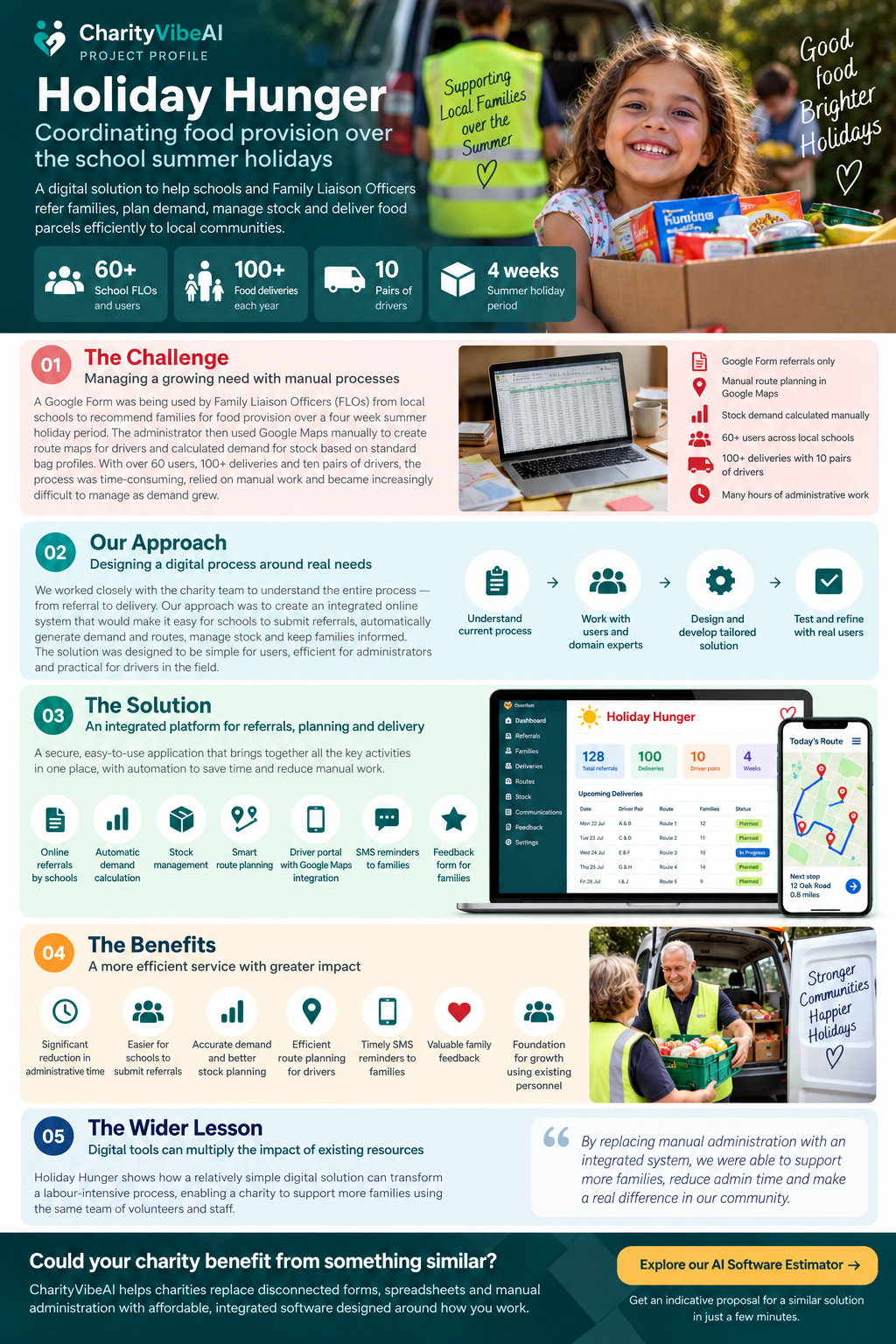
60+ users | 100+ deliveries | 10 pairs of drivers | 4-week summer programme
Project Overview
Holiday Hunger is a community initiative designed to support families experiencing food insecurity during the four-week school summer holiday period.
Working with local schools and Family Liaison Officers (FLOs), the programme identifies families requiring additional food support and coordinates the preparation and delivery of food provisions directly to their homes.
With more than 60 users involved, over 100 deliveries to coordinate and ten pairs of volunteer drivers, the programme presented a significant logistical and administrative challenge.
Procium developed an integrated digital platform to replace fragmented manual processes with a coordinated system covering referrals, demand forecasting, stock management, delivery planning, driver navigation, family communications and feedback.
The objective was straightforward: reduce administration, improve operational efficiency and create the capacity to support more families without a corresponding increase in staffing.
01 — The Challenge
Managing a growing food support programme through disconnected and labour-intensive processes.
The Holiday Hunger programme relied on Family Liaison Officers from local schools to identify and refer families requiring food provisions during the summer holidays.
Referrals were submitted using a Google Form, providing a straightforward method for schools to recommend families for support.
However, once a referral had been received, almost every subsequent operational activity depended on manual administration.
The programme administrator was responsible for interpreting referral information, calculating the food provisions required, planning stock requirements and organising deliveries.
With more than 100 deliveries and ten pairs of volunteer drivers, coordinating the distribution of food parcels became particularly demanding.
Delivery routes were planned manually using Google Maps. Addresses had to be organised into suitable delivery groups, routes prepared for individual drivers and arrangements communicated separately.
At the same time, the administrator had to calculate demand for food supplies based on standard bag profiles, ensuring sufficient stock was available for the families being supported.
This created several significant challenges:
- Disconnected referral and delivery processes: Information submitted through Google Forms had to be manually transferred into operational planning.
- Time-consuming route planning: Delivery routes were prepared individually using Google Maps rather than generated automatically.
- Manual demand calculations: Food requirements had to be calculated from standard bag profiles and referral volumes.
- Complex stock coordination: Administrators needed to monitor food availability against changing demand.
- Volunteer driver coordination: Ten pairs of drivers needed clear routes, delivery information and practical directions.
- Repetitive family communications: Families needed regular information and reminders about forthcoming deliveries.
- Limited feedback collection: Gathering consistent feedback from families required additional administration.
- Restricted capacity for growth: Increasing the number of families supported would also increase the administrative workload.
The programme was delivering an essential service, but too much of the available time was being consumed by organising the work rather than delivering support. The central challenge was to make the programme scalable without requiring additional administrative personnel.
02 — Our Approach
Designing one connected process from referral to delivery.
Rather than simply improving the existing Google Form or automating individual spreadsheets, Procium approached Holiday Hunger as a complete operational process.
The starting point was to understand how information moved through the programme, from the initial school referral to the delivery of food provisions and subsequent family feedback.
Working around the charity's established procedures, we identified opportunities to connect activities that had previously required separate manual intervention.
Our approach focused on five principles:
- Capture information once — Allow Family Liaison Officers to submit referrals through a secure online portal, making that information available throughout the operational process.
- Generate demand automatically — Use the number of referred families and their associated food bag requirements to calculate the quantities of provisions needed.
- Automate delivery planning — Develop software capable of generating delivery routes and allocating deliveries into practical groups for volunteer drivers.
- Support volunteers in the field — Provide a smartphone-friendly driver portal with integration into Google Maps, allowing drivers to follow their allocated routes and navigate between delivery addresses.
- Keep families informed — Use automated SMS reminders and digital feedback forms to improve communications and gather information about the service.
The goal was to create a single coordinated workflow in which each stage used information already captured by the system.
See Holiday Hunger in Action
Explore how Holiday Hunger brings family referrals, food distribution, delivery planning and volunteer coordination together in one integrated platform.
Weekly delivery sessions
Each weekly delivery slot shows the number of drivers, planned and actual deliveries, variance and status at a glance.
03 — The Solution
An integrated digital platform for managing food referrals, demand, stock and deliveries.
Procium developed a bespoke web application bringing the principal activities of the Holiday Hunger programme into one system.
Online School Referral Portal
Family Liaison Officers can submit referrals directly through an online portal, providing the information required to identify families and plan their food provision. This replaces the dependence on a standalone Google Form and makes referral information immediately available for subsequent planning.
Automated Food Demand Calculation
The system uses referral information and standard food bag profiles to calculate the demand for provisions. Rather than manually analysing referral numbers and determining food requirements, administrators can use system-generated demand information to support procurement and preparation.
Integrated Stock Management
Stock requirements and available supplies can be monitored together, providing administrators with a clearer view of whether sufficient provisions are available to meet demand. This makes stock planning easier and helps identify potential shortages before deliveries are due.
Automated Delivery Route Planning
One of the most significant improvements was the development of Procium's own route-planning functionality. Instead of manually organising delivery addresses in Google Maps, the system generates delivery routes from the referral and delivery information. This reduces the time required to prepare routes for the ten pairs of volunteer drivers.
Smartphone Driver Portal
Drivers access their delivery information through a mobile-friendly portal. The system integrates with Google Maps to provide navigation while drivers are out delivering food provisions. This connects central planning with the practical work of volunteers in the field.
Automated SMS Reminders
Families receive SMS reminders each week, informing them that their next food delivery is scheduled for the following day. This reduces the need for administrators to prepare and send individual reminders manually and helps families anticipate their deliveries.
Family Feedback
The system also provides a feedback form for participating families. This creates a structured way to collect feedback about the service and identify opportunities for improvement.
The result is a connected operational platform that supports the entire journey from school referral to family delivery and feedback.
04 — The Benefits
Less administration. Better coordination. Greater capacity to help families.
The Holiday Hunger platform transformed a series of disconnected manual activities into a more efficient and coordinated process.
Significant Administrative Time Savings
Automated demand calculations, route generation and family communications eliminated many repetitive administrative tasks. Many hours previously spent preparing delivery information, calculating food requirements and coordinating drivers were saved.
More Efficient Delivery Planning
Automatically generated routes reduced the need to manually organise addresses in Google Maps. Drivers could access their allocated deliveries through a smartphone portal and use familiar Google Maps navigation to reach families.
Improved Demand and Stock Visibility
By linking referrals to standard food bag profiles, administrators gained a clearer picture of anticipated demand. Stock availability and requirements could be monitored more closely, improving the coordination of food preparation and distribution.
Easier Coordination of Volunteers
A shared platform reduced the need to communicate route information and delivery arrangements through separate manual processes. Volunteer drivers could access the information relevant to their deliveries directly.
More Consistent Family Communications
Automated weekly SMS reminders helped keep families informed while reducing the administrative effort involved in contacting them.
Better Opportunities for Feedback
Digital feedback forms provided a more structured way to hear from families receiving support.
A Foundation for Growth
Perhaps the most important benefit was the opportunity to expand the programme without a proportional increase in administrative resources. By automating routine tasks and connecting operational processes, the charity established a platform capable of supporting more referrals and deliveries using its existing personnel.
The technology did not replace the people delivering the service. It enabled them to achieve more with the time and resources available.
05 — The Wider Lesson
Digital tools can multiply the impact of existing charitable resources.
Holiday Hunger demonstrates an important principle for charities and community organisations: growth does not always require more administrative staff.
Many charities already have committed volunteers, established referral networks and effective ways of reaching people who need support.
What they often lack is the technology to connect those activities efficiently.
In Holiday Hunger, a simple online form had helped collect referrals, but the real administrative burden lay in everything that happened afterwards.
By connecting referrals, demand forecasting, stock management, route planning, driver navigation, communications and feedback, Procium helped transform the complete service delivery process.
The project demonstrates that affordable bespoke software can deliver value beyond replacing spreadsheets.
It can improve coordination, reduce repetitive work and create the operational capacity for charities to extend their reach.
The greatest benefit of automation is not simply doing the same work faster. It is enabling a charity to do more good with the resources it already has.
FACT SHEET
Build your next step