
Project spotlight
Riverside Benefits Advice
From Fragmented Google Workspace Processes to an Integrated Benefits Advice Platform
Procium Project Profile
Online Referrals | Case Management | Adviser Workflows | Gmail Integration | SMS Communications | Appointment Scheduling
Project Overview
Riverside Benefits Advice provides support to people who need assistance navigating the benefits system, completing applications and managing the often complex processes associated with claiming financial support.
The service receives referrals from charities, GP surgeries and other community organisations, connecting people in need with advisers who can guide them through the application process.
As the service developed, its administration became increasingly dependent on a collection of Google Workspace tools, including Google Forms, spreadsheets, email and documents.
Although these tools had initially provided an affordable way to manage referrals, they were no longer sufficiently reliable or integrated to support the growing complexity of the service.
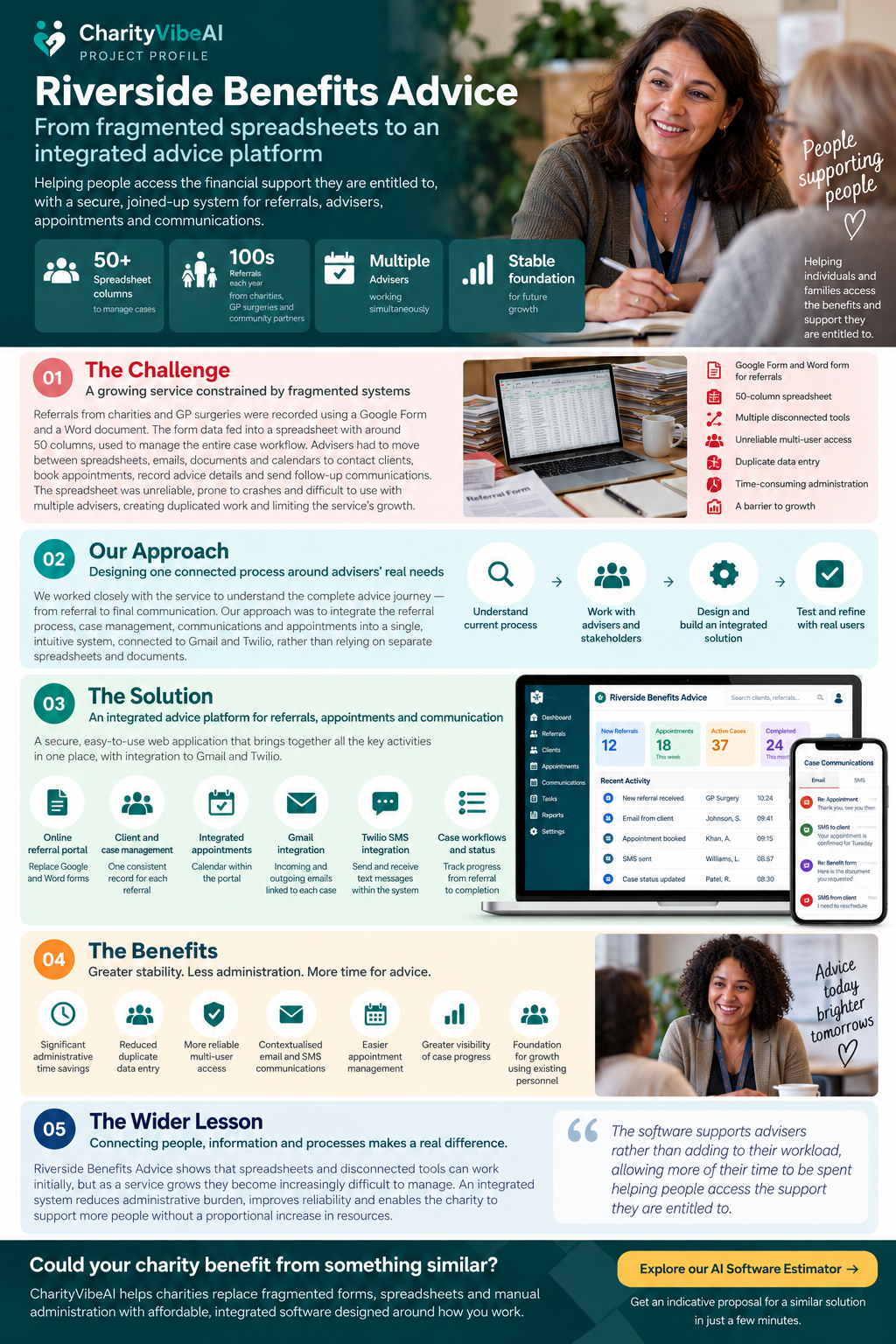
Procium developed a bespoke benefits advice case-management platform to bring these activities together in one secure, coordinated working environment.
The objective was to improve reliability, reduce repetitive administration, support advisers more effectively and provide a stable foundation for the future growth of the service.
01
The Challenge
A growing advice service constrained by fragmented systems, duplicated administration and unreliable multi-user working.
The benefits advice service originally relied on a combination of Google Forms and Word documents to record referrals from charities, GP surgeries and other organisations.
These referrals identified people who needed assistance completing benefits applications and accessing appropriate advice.
Information submitted through the Google Form was transferred into a central spreadsheet containing approximately 50 columns of data.
This spreadsheet became the principal mechanism for managing the entire referral and advice process.
Each case involved a sequence of activities, including:
Receiving and recording the initial referral.
Allocating or identifying the appropriate adviser.
Contacting the referred person by telephone.
Booking an advice appointment.
Sending appointment confirmations by email or SMS.
Managing changes to appointment dates and times.
Recording information gathered during advice appointments.
Tracking the progress and status of the referral.
Completing the advice appointment and associated casework.
Sending follow-up communications and recording outcomes.
Although the spreadsheet provided a central record, the actual work was carried out across multiple disconnected applications.
Advisers moved repeatedly between spreadsheets, Gmail, Word documents and calendars to manage individual cases.
Communications had to be matched manually to the appropriate client and referral, while changes to appointments and case status required updates across different parts of the system.
As more advisers used the service simultaneously, the limitations became increasingly apparent.
The spreadsheet-based workflow suffered from stability problems, crashes and difficulties with multi-user access.
This created uncertainty over the accuracy and availability of information, interrupted advisers' work and increased the administrative effort required to keep cases moving.
The principal challenges were:
Fragmented case management: Referrals, appointments, documents and communications were managed across separate Google Workspace applications.
An increasingly complex spreadsheet: Approximately 50 columns were required to track the many stages and details of each referral.
Unreliable multi-user access: Crashes and concurrent-working problems disrupted normal operations.
Duplicated data entry: Information often had to be recorded or updated in more than one place.
Disconnected communications: Emails and SMS messages were not automatically associated with the relevant client, referral or adviser.
Manual appointment coordination: Booking, moving and confirming appointments required activity across multiple systems.
Limited workflow visibility: Understanding the current position of a case depended on manually maintained information.
Barriers to growth: The administrative burden and reliability problems made it increasingly difficult to expand the service.
The existing arrangement had reached the limits of what could reasonably be achieved through loosely connected productivity tools.
The challenge was to replace a fragile administrative process with a reliable, integrated system designed around the way benefits advisers actually work.
02
Our Approach
Designing one connected working environment around the complete advice journey.
Procium approached the project as a transformation of the entire referral and case-management process, rather than simply replacing the existing spreadsheet.
The starting point was to understand how a referral moved through the service, from its initial submission by a GP surgery or charity to the completion of advice and any subsequent communications.
Working with the service's operational requirements, we identified the information advisers needed, the actions they performed and the points at which disconnected systems created unnecessary work.
Our approach was built around five principles.
Capture referrals directly
Replace separate Google and Word referral forms with an online referral portal.
This allows referral information to enter the case-management system directly, without requiring manual transfer into a spreadsheet.
Create one authoritative case record
Bring client details, referrals, appointments, advice activity and case status together around a consistent record.
This gives advisers a single place to understand what has happened, what needs to happen next and who is responsible.
Integrate communications into the case
Connect the application to Gmail and Twilio so that email and SMS communications can be managed in the context of the relevant client and referral.
Incoming communications can be associated with the appropriate adviser and displayed in their working inbox, reducing the need to search through separate messaging systems.
Bring appointments into the same workflow
Integrate calendar and appointment management directly into the advice portal.
Advisers can coordinate appointments and update case information without repeatedly moving between disconnected applications.
Make the system intuitive and consistent
Design a joined-up interface in which advisers can perform their routine tasks, update statuses and access relevant information from one working environment.
The goal was to remove unnecessary administrative steps while making the service more reliable and easier to operate.
The central design principle was simple: information should be entered once, remain connected to the relevant case and be available wherever it is needed.
See Riverside Benefits Advice in Action
Explore how Riverside Benefits Advice brings client referrals, case management, adviser appointments and communications together in one integrated platform.
Single place for all workflow actions
03
The Solution
A secure, integrated benefits advice platform connecting referrals, advisers, appointments and communications.
Procium developed a bespoke web-based case-management application designed around the practical needs of a benefits advice service.
Rather than depending on a central spreadsheet and multiple disconnected applications, the platform brings the principal administrative and operational functions together.
Online Referral Portal
Charities, GP surgeries and other authorised referral sources can submit referrals through an online form.
The information is captured directly within the system, creating the foundation for a new client and referral record.
This removes the need to manually transfer information from Google Forms or Word documents into a separate spreadsheet.
Centralised Client and Referral Management
Each referral is managed through a structured case record containing the information required to support the advice process.
Advisers can review referral details, record activity, manage the case workflow and update its status from one place.
This provides a more consistent and accessible view of each client's progress.
Adviser Workflow Management
The platform supports the stages involved in managing a benefits advice referral, from initial contact through appointment booking, advice activity, follow-up and completion.
Actions and status changes can be recorded directly against the relevant referral.
This replaces the need to interpret and maintain numerous spreadsheet columns to understand the current position of a case.
Integrated Gmail Communications
Gmail is integrated with the advice portal so that incoming email correspondence can be associated with the relevant client, referral and adviser.
Messages can be presented within the adviser's working environment, preserving the context of the communication.
Threaded correspondence makes it easier to follow conversations and understand the history of contact without repeatedly searching through a separate Gmail inbox.
Integrated SMS Through Twilio
Twilio provides the SMS communications capability.
Text messages can be managed in connection with the relevant client and referral, supporting appointment confirmations, reminders and other case-related communications.
Incoming SMS messages can also be routed into the appropriate adviser workflow, helping maintain a more complete communication history.
Integrated Calendar and Appointment Management
The system brings appointment scheduling into the case-management environment.
Advisers can book appointments, manage changes and coordinate their schedules alongside the associated referral information.
This reduces the need to switch between spreadsheets, separate calendars and email messages when organising advice sessions.
Centralised Case History
The platform brings together case activity, communications, appointments and workflow changes to provide a clearer record of the work undertaken.
This improves continuity when advisers return to a case or need to understand previous interactions.
A Consistent Adviser Workspace
A unified interface allows advisers to carry out routine activities in one place.
Rather than navigating several disconnected applications, advisers work within a system designed specifically for the sequence of tasks involved in benefits advice.
The result is a joined-up platform in which referrals, appointments, communications and case activity operate as parts of the same process.
04
The Benefits
Greater stability. Less duplication. More time available for advice.
The integrated benefits advice platform addresses the operational weaknesses of the previous spreadsheet-based approach while providing a more scalable foundation for the service.
Improved System Stability
Moving away from a complex shared spreadsheet reduced dependence on a tool that had become increasingly unreliable under multi-user working.
A dedicated case-management application provides a more structured environment for managing concurrent activity.
Significant Administrative Time Savings
By connecting referrals, communications, appointments and workflow updates, the system removes many repetitive administrative tasks.
Hours previously spent moving information between applications, maintaining spreadsheet records and coordinating separate processes can instead be directed towards supporting clients.
Reduced Duplicate Data Entry
Information captured through the referral portal becomes part of the central case record.
Advisers can reuse that information throughout the advice process rather than repeatedly copying or re-entering it.
Contextualised Communications
Email and SMS messages are associated with the relevant client and referral.
This reduces the effort required to identify correspondence, locate case information and maintain continuity in communications.
Better Adviser Coordination
Integrated appointment management, case statuses and adviser inboxes provide a clearer view of ongoing work.
Advisers can more easily identify what needs attention and manage their responsibilities within a consistent working environment.
Improved Visibility of Case Progress
Structured workflow information makes it easier to understand the current status of referrals and the actions required to progress them.
This reduces reliance on manually maintained spreadsheet columns and informal communication between advisers.
A More Consistent Client Experience
Connected case information and communications support more organised appointment management and follow-up.
Clients benefit from a service in which advisers have better access to the information and history needed to support them.
A Foundation for Sustainable Growth
Perhaps the most important outcome is that the service is no longer constrained by the practical limitations of its original spreadsheet-based system.
A more stable and integrated platform creates the capacity to manage increasing referral volumes without a corresponding increase in repetitive administration.
The software supports advisers rather than adding to their workload, allowing more of their time to be spent helping people access the benefits and financial support they need.
05
The Wider Lesson
Replacing spreadsheets is only the beginning. The real value comes from connecting the entire service.
Riverside Benefits Advice illustrates a challenge faced by many small charities.
Google Workspace and similar productivity tools provide an affordable and accessible way to establish a service.
Forms can collect information, spreadsheets can track activity, calendars can organise appointments and email can support communication.
But as an organisation grows, these tools can become increasingly difficult to coordinate.
The problem is not necessarily any individual application. It is the amount of manual work required to keep information consistent across them.
A referral recorded in a form must become a spreadsheet entry. That entry must be connected to an adviser, an appointment, an email conversation, an SMS reminder and an eventual outcome.
When those connections depend on manual effort, the administrative burden grows with every additional case.
Procium's approach is to bring those activities together within a system designed around the charity's actual processes.
For Riverside Benefits Advice, this meant replacing fragmented administration with a single, integrated environment supporting the complete advice journey.
The greatest value of bespoke charity software is not simply digitising individual tasks. It is connecting people, information and processes so that the whole organisation can work more effectively.
FACT SHEET
Benefit Advice fact sheet
Build your next step